
Field Note: May/June
Get ready for some book recs

Learning how to write (again)
Recently, I decided to join a fiction writing workshop. This would be the first time I’ve written fiction in twenty years.
Why? Several months ago, I wrote about how artificial intelligence tools were going to empower people to learn and build things at unprecedented speed and scale. And I think that has happened for many people and in many cases. However, an increase in signal doesn’t mean there’s no increase in noise. In fact, some days I feel like all I see is noise. I check LinkedIn and immediately I’m barraged by a tedium of ones and zeros masquerading as authorship. It got to the point where I was feeling ill when I encountered slop.
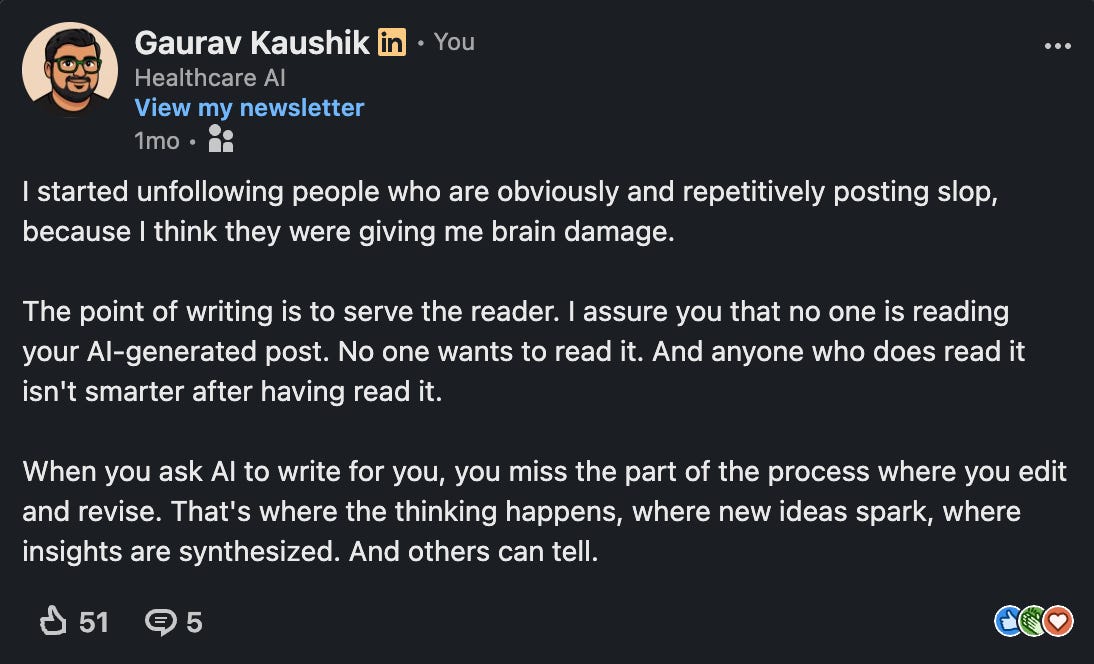
You see it too, right? An inarticulate co-worker suddenly has the eloquence of a seasoned executive, and the posture of a marionette. You’re exchanging emails with someone, then they include the phrase “load-bearing” in their response. You get the sense that you’re speaking to a robot in a mask. Your fingernails itch. You reach for the nearest bottle. Unfortunately, it’s a bottle of kombucha because you’re 40 and the world doesn’t look the way you thought it would and neither do you. Maybe some probiotics will help (they don’t). The robot politely nudges your last email.
So (in a decision that definitely doesn’t represent a midlife crisis) I joined a writer’s workshop.
My goal was to find out what I could do, literarily speaking. Writers will sometimes talk about how they’re not very smart or even particularly empathetic (or Good). But when they’re writing, they find they’re bigger on the inside. They rummage around and find words that are greater than themselves (better than Good). So I wanted to reach inside my brain like a TARDIS.
For workshop, I wrote two stories. One is about a guy who moves from India to the U.S. as a kid and now is an aging tech worker. All he wants is a cup of coffee, and instead he gets a lesson in depersonalization (try not to read too hard into this). The other story is about a couple who’s having an issue with their gardener. It started as a joke and turned into a meditation on processing unmet expectations (also don’t read into this).
Along with short stories, I wrote several micro-stories: a guy remembers how to cut an onion, two cousins sit over tea, a couple discusses vacation plans. With each story, where-I-intended-to-go and where-I-ended-up were two very different places. Upon reflection, each micro-story was about people who talk past each other, communicate in gestures, and use objects to say “I love you” without speaking.
(Try not to read into this.)
I also wrote about a guy walking from his office to Penn Station. The way he describes what he sees shows that he is absolutely madly in love with the city. Not just that, the city shapes how he moves, how he speaks. He pays attention to people in the street and falls in and out of love with them instantly.
(Try not to read into this.)
I also learned that my favorite thing about writing is coming up with ideas. Actually getting words on a page can be a slog. But going on a long walk and having an idea click into place? Incredible. When you finally find a “fix” for how to connect two disparate elements in your story? Hoo baby.
Then there’s the thrill of editing. How can I sharpen this image? Where can two words achieve what fifteen are doing now? At a time where everyone is writing in bloviated, AI-generated run-ons, it’s refreshing to feel something from just a handful of syllables. It’s like solving a puzzle. I quit playing NYT Games.
What I’ve been reading
One of the unexpected benefits of joining a workshop is that you get a teacher with great taste who exposes you to new writers and stories. So let me turn you on to the good shit.
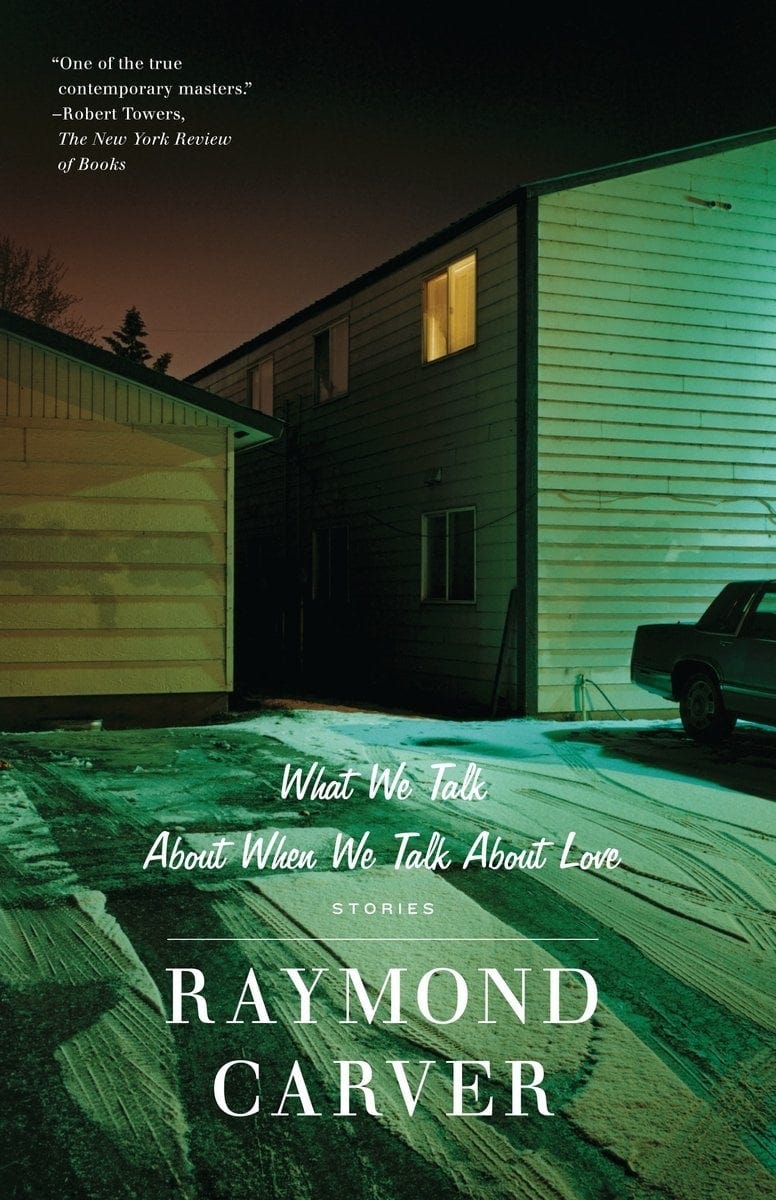
Let’s start with Raymond Carver. A few months ago, I would not have been able to tell you the difference between Raymond Carver and Raymond Chandler. Now I’ve read a couple dozen of his stories.
Carver’s economy of language is precise and leaves ample room for the reader. He doesn’t indulge in flowery prose. Nor is he trying to convince you how clever he is. Carver wants to tell you a story that makes you think and makes your heart beat faster.
In “Principles of a story,” Carver writes that “VS Pritchett’s definition of a short story is ‘something glimpsed from the corner of the eye, in passing.’ Notice the ‘glimpse’ part of this. First the glimpse. Then the glimpse given life, turned into something that illuminates the moment and [has] even further-ranging consequences and meaning. The short story writer’s task is to invest the glimpse with all that is in his power.”
Here’s how Carver “invests the glimpse” in the opening to “Why Don’t You Dance?”:
In the kitchen, he poured another drink and looked at the bedroom suite in his front yard. The mattress was stripped and the candy-striped sheets lay beside two pillows on the chiffonier. Except for that, things looked much the way they had in the bedroom—nightstand and reading lamp on his side of the bed, nightstand and reading lamp on her side.
His side, her side.
He considered this as he sipped the whiskey.
Seventy-four words. That’s as much backstory as you’re gonna get.
Do you need any more?
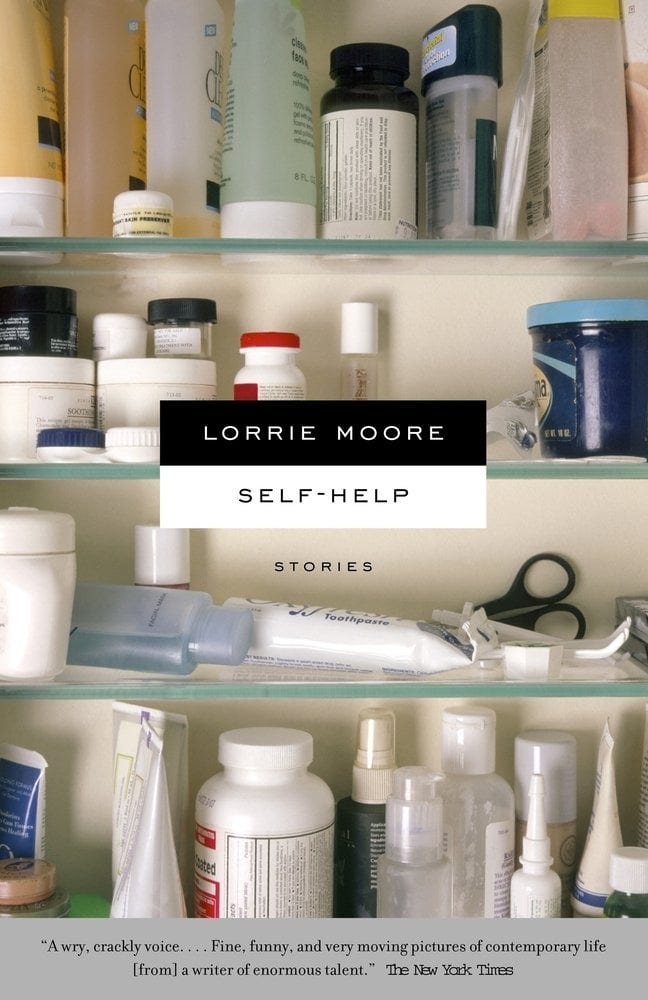
Let’s talk about Lorrie Moore. If Carver is a hammer, Moore is (ironically) a knife. Her best stories have engines, plural, that make the page hum.
And she’s hysterical. Her jokes bite unexpectedly. Several times, while reading her debut collection, Self-Help, I put it down to admire a turn that she’d taken, pausing just to say, “God damn it, Lorrie, you can’t keep getting away with this.” But she does.
For example, she manages to use second person in a way that doesn’t feel trite. In a way that wraps you in her world.
In the incredible “How to Talk to Your Mother (Notes)”, Moore walks back through time, gradually revealing more details that constantly re-contextualize what you just read. Consider this triplet in the middle:
1971. Go for long walks to get away from her. Walk through wooded areas, there is a life there you have forgotten. The smells and sounds seem sudden, unchanged, exact, the papery crunch of the leaves, the mouldering sachet of the mud. The trees are crooked as backs, the fence posts splintered, trusting and precarious in their solid grasp of arms, the asters spindly, dry, white, havishammed (Havishammed!) by frost. Find a beautiful reddish stone and bring it home for your mother. Kiss her. Say: “This is for you.” She grasps it and smiles. “You were always such a sensitive child,” she says. Say: “Yeah, I know.”
1970. You are pregnant again. Try to decide what you should do. Get your hair chopped, short as a boy’s.
1969. Mankind leaps upon the moon. Disposable diapers are first sold in supermarkets. Have occasional affairs with absurd, silly men who tell you to grow your hair to your waist and who, when you are sad, tickle your ribs to cheer you up. Moonlight through the blinds stripes you like zebras. You laugh. You never marry.
Going backwards in time could just be a clever but ultimately cute and unnecessary conceit. Moore, however, demonstrates how this frame changes your understanding of the narrative. After reading 1970, you realize what decision she made about her pregnancy. After reading 1969, you understand her decision to cut her hair. Some threads planted early only pay off near the end of the story. I can’t really articulate why this works or why it’s so satisfying when all the pieces click. Only that it does.
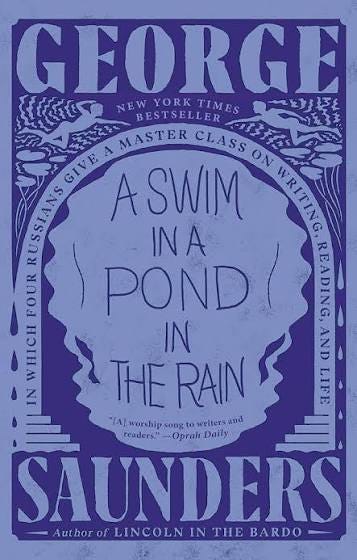
I also read George Saunders’ “A Swim in a Pond in the Rain,” in which he intercalates short stories from classic Russian authors (Tolstoy, Gogol, Chekhov, Turgenev) with a close reading and some reflections on their power as writers.
Saunders methodically and cheerfully reveals the engines underneath the stories, the small touches that bring characters to life, the seemingly effortless way the plot propels forward and escalates. He reveals the seams that make each story great.
Saunders’ frameworks clicked for me, I think, because he’s a technical guy. He studied geophysical engineering at the Colorado School of Mines. After college, he worked as a field geophysicist, including a stretch on an oil exploration crew in Sumatra. He had a series of blue collar jobs, then became a technical writer at an environmental engineering firm. Seven years later, he got his MFA at Syracuse (studying under Tobias Wolff, whose story “Bullet in the Brain” is a must read).
He thinks about stories in terms of feedback loops. He says there’s a meter in his head that swings between positive and negative; anywhere he sees that a story swings toward negative, he edits, then re-reads and re-meters. When he says every sentence must carry the reader’s attention forward, that there must be escalation in each part of a story, I see force diagrams, hear conservation of momentum.
Saunders’ story is, in essence, a machine. It must effectively and efficiently carry the reader toward the ending and change them.
By the last story (a compact masterpiece from Tolstoy) I could clearly see the machine, admire its efficiency and dynamism, the way the story developed with variety, how every page was a critical component. And then at the end I cried.
Buy you some books (all links Bookshop.org, I make no money off this):
p.s. Knicks in fiiiiiiive foreeeeeveerrr