
Field Note: March
Butler & Vonnegut, Newsom, Gaining Consciousness

Hello friends
It’s been a real pleasure to rediscover writing. Getting ideas out of my head, refining what I think, revealing what I don’t. Thanks for coming along for the ride.
I have a few essays I’m working on now, and each requires some more thought and research. But I want to keep writing, and I figured not every thought requires a full essay. So here is my first in a series of Field Notes, or short updates.
What I’ve been reading
Last fall, I started a book club with some of my neighbors. We just wrapped up Kindred by Octavia Butler, our selection for February. This is my third Butler book of the year, after reading both Parable of the Sower and Parable of the Talents in January.
I wish I had discovered her sooner.
There are parts of Butler’s craft that I’m not completely attuned to. She tended to tell more than show, especially in Kindred, an earlier work. But I like to read like I’m putting a puzzle together. Show me the negative space and then let me pop a piece in.
That said, she understood our past and drew conclusions about our future so keenly. Were she alive today, I sense she would’ve been disappointed but not at all surprised.
I also read Stefan Zweig’s biography of Montaigne, published in 1941. Zweig deliberately overdosed on barbiturates in 1942, fearing that the future had nothing to offer him but destruction. Yet he found so much beauty in Montaigne’s life, who had managed to survive one of the worst plagues in recorded history while dedicating his life to knowledge (if you haven’t read Montaigne, he pioneered the personal essay). If only Zweig had held on for another few years.
After that, I needed a little levity, so I’m reading Pity the Reader: On Writing with Style, which has Kurt Vonnegut’s lessons on writing. It’s mostly excerpts from his canon with insightful commentary from his friend and former Iowa Workshop student, Suzanne McConnell.
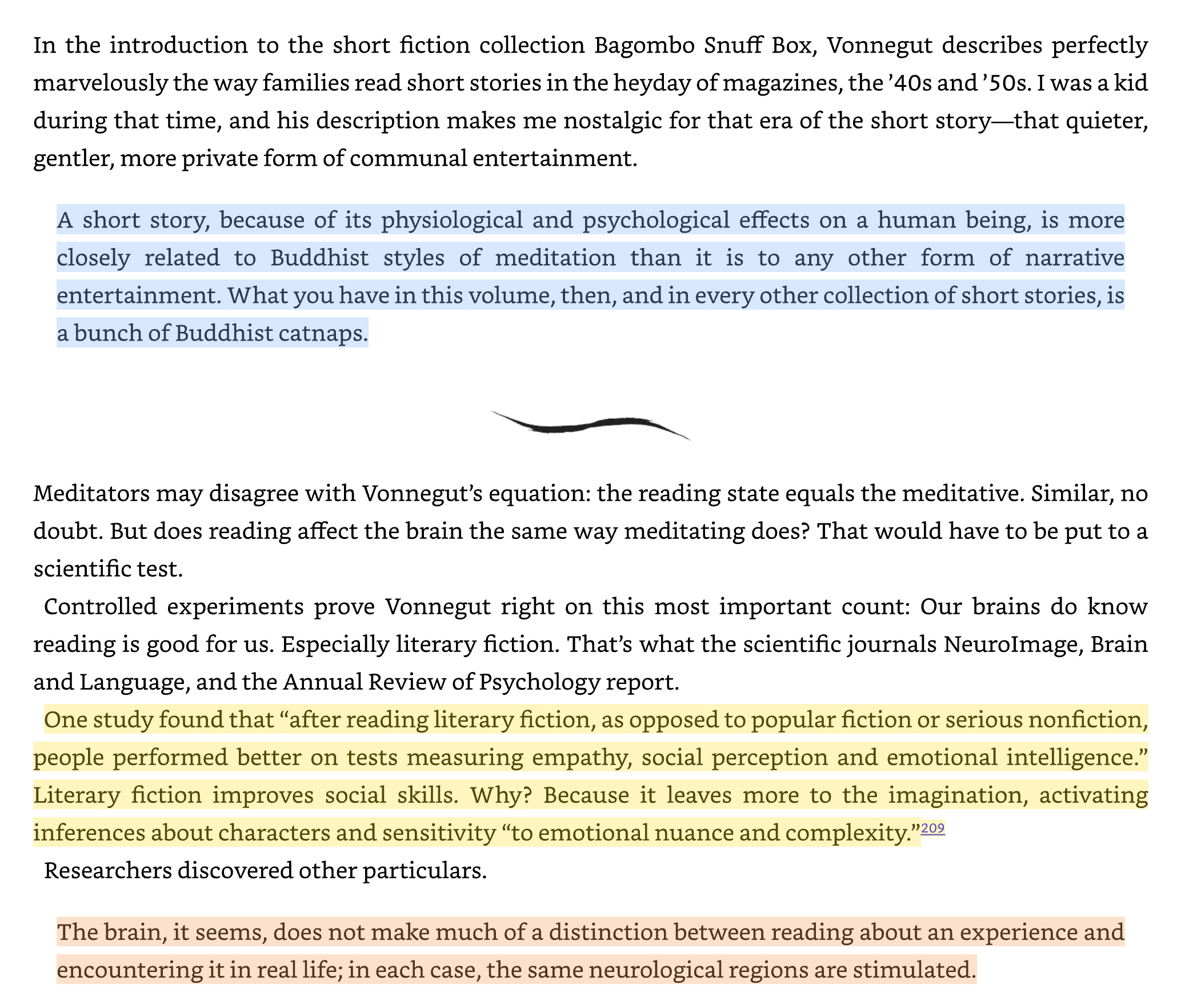
Vonnegut considered writing a spiritual practice. Here, McConnell and Vonnegut comment on the connection between reading short stories, Buddhist meditation, and our neurological responses to both:
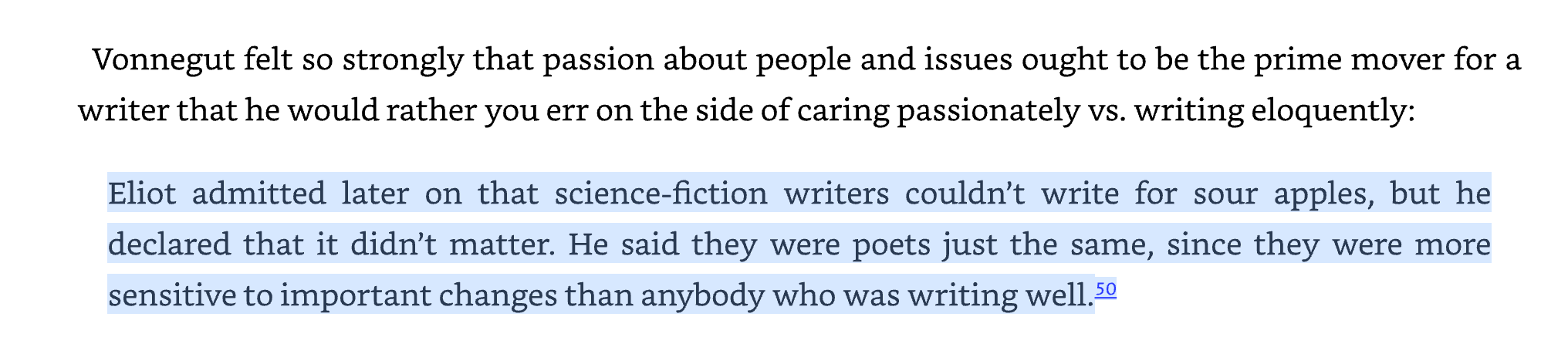
I don’t know if Vonnegut ever read Butler, but we have hints on how he would feel about her:
I love Vonnegut. I remember the morning he died, it was a rainy one. I don’t remember getting out of bed.
What I’ve been listening to
Recently, I’ve been on a Joanna Newsom kick, and she sounds very different to my now-39-year-old ears.
The naïve read on Newsom is that she was part of the freak folk movement (I guess because she’s from Norcal), or that she was twee because her voice had a high register.
The truth is she is a remarkable poet with an incredible mastery of metaphor, meter, pace, and tone. She doesn’t call herself a harpist, she calls herself a harper. She uses the power of the instrument to reflect the emotion of the words underneath. Between the two, she builds remarkable tension, even outright violence, in songs like “Baby Birch” and “Sawdust & Diamonds,” the latter being one of the best songs ever composed, for my dollar. Then she invites you to sit in that tension.
“Sawdust & Diamonds” deserves its own essay, but first let’s dip a toe. Consider the lines:
Drop a bell off of the dock
Blot it out in the sea
Drowning mute as a rock;
and sounding mutiny
Meanwhile, Newsom deftly plucks arpeggios, creating the sound of bubbling, gurgling water, a feeling of rushing down deep into the dark.
The bell is drowning, drowning. And us with it. Until:
There’s a light in the wings, hits the system of strings
From the side, where they swing —
See the wires, the wires, the wires
The pace picks up, the register lifts, and we’re rising. It’s the same playbook Radiohead will use on the incredible “Weird Fishes/Arpeggi” off In Rainbows a year later.
It’s been eleven years without a new Joanna Newsom album, but she hasn’t stopped writing. I’ve read that her latest songs are focused on family. I’d be delighted to hear that version of her.
New to Newsom? Here’s a playlist on Apple Music (she’s not on Spotify).
What I’ve been paying attention to
My wonderful son is two and a half, and so naturally I’ve been waiting for him to fully gain consciousness.
I think it happened this week when he had a 101-degree fever. He was staring out into the middle distance, and when I tried to get his attention, he suddenly turned to me and said, “You are Daddy.”
He now describes everything I do. They half sound like narration and half like commandments: “You are here. You are drinking coffee.”
I’ll never get over how the human brain folds itself like origami, creating more and more intricate, more beautiful, more terrible shapes.
So it goes!